Poland · Cultural · 3 parts
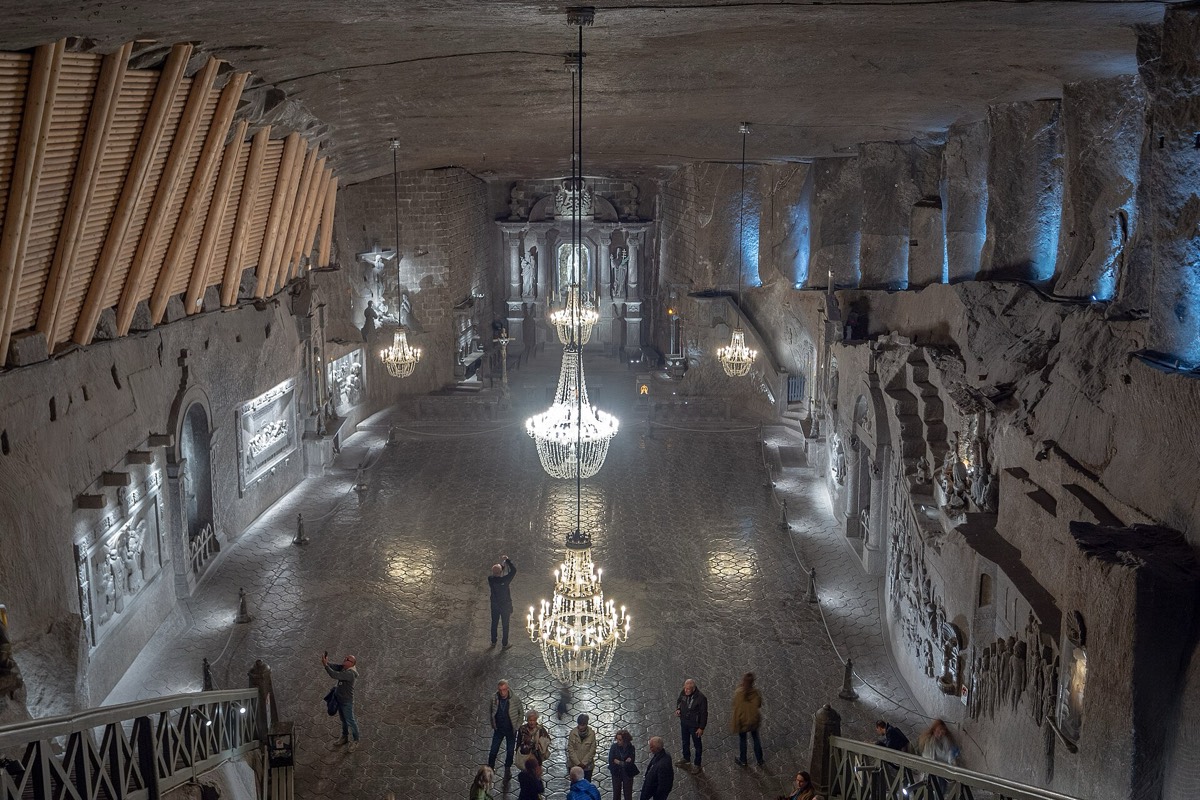
UNESCO World Heritage site since 1978Wieliczka and Bochnia Royal Salt Mines
What entry costs
Why it's on the list
UNESCO lists a place when it meets at least one of ten criteria. Wieliczka and Bochnia Royal Salt Mines meets one, in our own words:
A landmark of its kind
An outstanding example of a kind of building or landscape that marks a stage in human history.
Criterion (iv)
On the map
Where the site is, and the places around it. Tap a dot for its price. Open the full map
Cultural Natural Mixed Other famous sights Prices checked In Danger
Map: OpenFreeMap, OpenMapTiles and OpenStreetMap contributors. Site positions from UNESCO's open data. "In Danger": on UNESCO's List of World Heritage in Danger.
Nearby
Within 100 km (62 miles), as the crow flies.
World Heritage sites
- Historic Centre of KrakówPoland · listed 197813 km (8 miles)From 20 PLN
- Kalwaria ZebrzydowskaPoland · listed 199930 km (19 miles)
- Auschwitz Birkenau German Nazi Camp (1940–1945)Poland · listed 197964 km (40 miles)From Free
- Wooden Churches of the Slovak CarpathiansSlovakia · listed 200880 km (50 miles)
- Wooden Tserkvas of Poland and UkrainePoland, Ukraine · listed 201385 km (53 miles)
- Wooden Churches of Southern MałopolskaPoland · listed 200388 km (54 miles)
Entry prices we've checked
- Oskar Schindler's Enamel FactoryKraków, Poland11 km (7 miles)60 PLN
- Wawel Royal CastleKraków, Poland12 km (8 miles)95 PLN
- St Mary's Basilica, KrakówKraków, Poland13 km (8 miles)20 PLN
- Auschwitz-Birkenau MemorialOświęcim, Poland62 km (38 miles)Free
About the listing
- Country
- Poland
- Type
- Cultural
- Listed by UNESCO
- 1978
- Extended
- 2008 and 2013
- Area
- 11 km² (4.3 square miles)
- Separate parts
- 3
Questions
When did Wieliczka and Bochnia Royal Salt Mines become a World Heritage site?
In 1978, when UNESCO added it to the World Heritage List; it was extended in 2008 and 2013.
Why is Wieliczka and Bochnia Royal Salt Mines a World Heritage site?
UNESCO listed it for meeting one of its ten criteria: an outstanding example of a kind of building or landscape that marks a stage in human history.