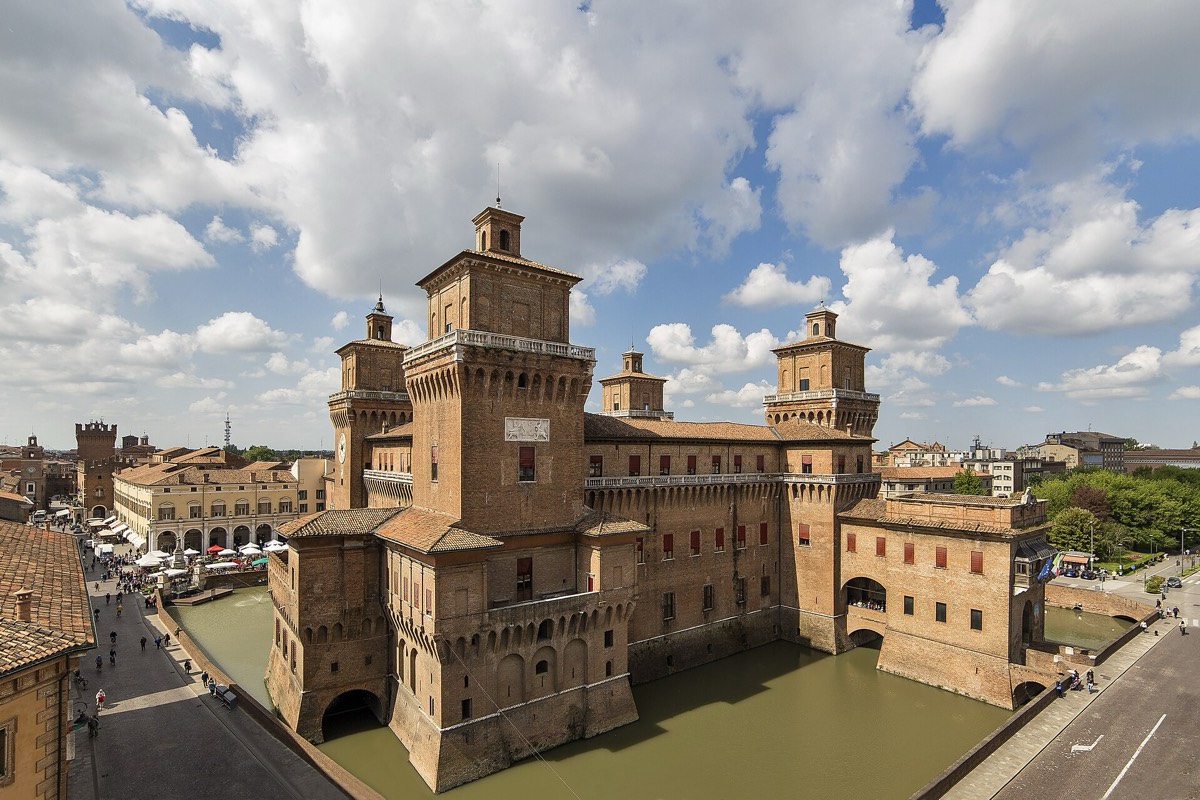
Italy · Cultural · 2 parts
UNESCO World Heritage site since 1995Ferrara, City of the Renaissance, and its Po Delta
What entry costs
Why it's on the list
UNESCO lists a place when it meets at least one of ten criteria. Ferrara, City of the Renaissance, and its Po Delta meets four, in our own words:
An exchange of ideas
Shows ideas in architecture, art, technology or town planning passing between cultures.
Criterion (ii)
Rare evidence of a culture
Unique or rare evidence of a civilisation or cultural tradition, living or lost.
Criterion (iii)
A landmark of its kind
An outstanding example of a kind of building or landscape that marks a stage in human history.
Criterion (iv)
A traditional way of life
An outstanding example of how people have traditionally settled and used the land or sea.
Criterion (v)
On the map
Where the site is, and the places around it. Tap a dot for its price. Open the full map
Cultural Natural Mixed Other famous sights Prices checked In Danger
Map: OpenFreeMap, OpenMapTiles and OpenStreetMap contributors. Site positions from UNESCO's open data. "In Danger": on UNESCO's List of World Heritage in Danger.
Nearby
Within 100 km (62 miles), as the crow flies.
World Heritage sites
- The Porticoes of BolognaItaly · listed 202145 km (28 miles)
- Cathedral, Torre Civica and Piazza Grande, ModenaItaly · listed 199759 km (37 miles)
- Early Christian Monuments of RavennaItaly · listed 199665 km (40 miles)From €14.50
- Botanical Garden (Orto Botanico), PaduaItaly · listed 199766 km (41 miles)From €15
- Padua’s fourteenth-century fresco cyclesItaly · listed 202167 km (42 miles)From €16
- Mantua and SabbionetaItaly · listed 200874 km (46 miles)From €18
Entry prices we've checked
- Ravenna MosaicsRavenna, Italy65 km (40 miles)€14.50
- Padua Botanical Garden (Orto Botanico)Padua, Italy66 km (41 miles)€15
- Scrovegni ChapelPadua, Italy67 km (42 miles)€16
- Palazzo TeMantua, Italy73 km (46 miles)€18
- Ducal Palace, MantuaMantua, Italy74 km (46 miles)€18
- Teatro OlimpicoVicenza, Italy79 km (49 miles)€12
- Verona ArenaVerona, Italy83 km (52 miles)€12
- Gallerie dell'Accademia, VeniceVenice, Italy86 km (54 miles)€20
About the listing
- Country
- Italy
- Type
- Cultural
- Listed by UNESCO
- 1995
- Extended
- 1999
- Area
- 467 km² (180 square miles)
- Separate parts
- 2
Questions
When did Ferrara, City of the Renaissance, and its Po Delta become a World Heritage site?
In 1995, when UNESCO added it to the World Heritage List; it was extended in 1999.
Why is Ferrara, City of the Renaissance, and its Po Delta a World Heritage site?
UNESCO listed it for meeting four of its ten criteria: shows ideas in architecture, art, technology or town planning passing between cultures; unique or rare evidence of a civilisation or cultural tradition, living or lost; an outstanding example of a kind of building or landscape that marks a stage in human history; an outstanding example of how people have traditionally settled and used the land or sea.