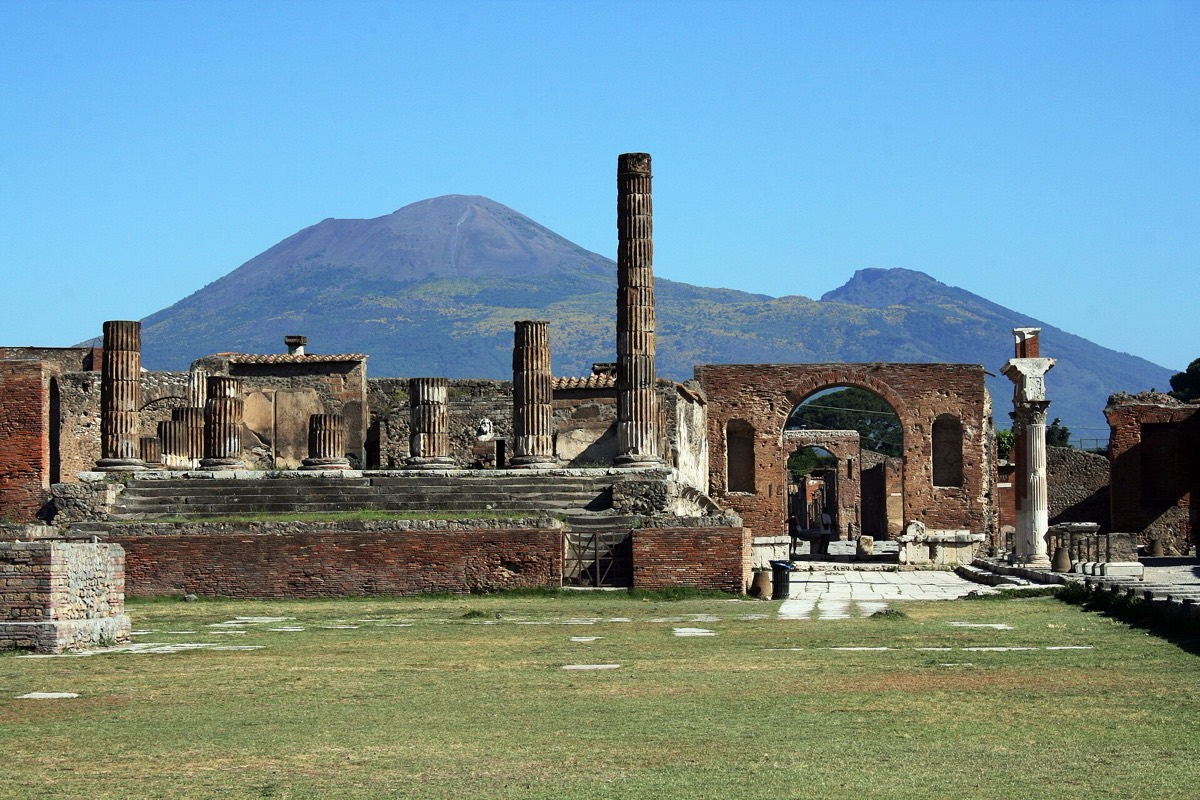
Italy · Cultural · 7 parts
UNESCO World Heritage site since 1997Pompeii, Herculaneum and Torre Annunziata
UNESCO's name: Archaeological Areas of Pompei, Herculaneum and Torre Annunziata
What entry costs
Why it's on the list
UNESCO lists a place when it meets at least one of ten criteria. Pompeii, Herculaneum and Torre Annunziata meets three, in our own words:
Rare evidence of a culture
Unique or rare evidence of a civilisation or cultural tradition, living or lost.
Criterion (iii)
A landmark of its kind
An outstanding example of a kind of building or landscape that marks a stage in human history.
Criterion (iv)
A traditional way of life
An outstanding example of how people have traditionally settled and used the land or sea.
Criterion (v)
On the map
Where the site is, and the places around it. Tap a dot for its price. Open the full map
Cultural Natural Mixed Other famous sights Prices checked In Danger
Map: OpenFreeMap, OpenMapTiles and OpenStreetMap contributors. Site positions from UNESCO's open data. "In Danger": on UNESCO's List of World Heritage in Danger.
Nearby
Within 100 km (62 miles), as the crow flies.
World Heritage sites
- Costiera AmalfitanaItaly · listed 199719 km (12 miles)
- Historic Centre of NaplesItaly · listed 199519 km (12 miles)From €18
- Royal Palace at CasertaItaly · listed 199737 km (23 miles)From €18
- Cilento, Paestum and VeliaItaly · listed 199887 km (54 miles)From €15
Entry prices we've checked
- Napoli Sotterranea (Underground Naples)Naples, Italy19 km (12 miles)€18
- Blue GrottoAnacapri, Capri, Italy30 km (19 miles)€6
- Royal Palace of CasertaCaserta, Italy37 km (23 miles)€18
- PaestumCapaccio Paestum, Italy60 km (37 miles)€15
About the listing
- Country
- Italy
- Type
- Cultural
- Listed by UNESCO
- 1997
- Area
- 98 hectares (242 acres)
- Separate parts
- 7
Questions
When did Pompeii, Herculaneum and Torre Annunziata become a World Heritage site?
In 1997, when UNESCO added it to the World Heritage List.
Why is Pompeii, Herculaneum and Torre Annunziata a World Heritage site?
UNESCO listed it for meeting three of its ten criteria: unique or rare evidence of a civilisation or cultural tradition, living or lost; an outstanding example of a kind of building or landscape that marks a stage in human history; an outstanding example of how people have traditionally settled and used the land or sea.