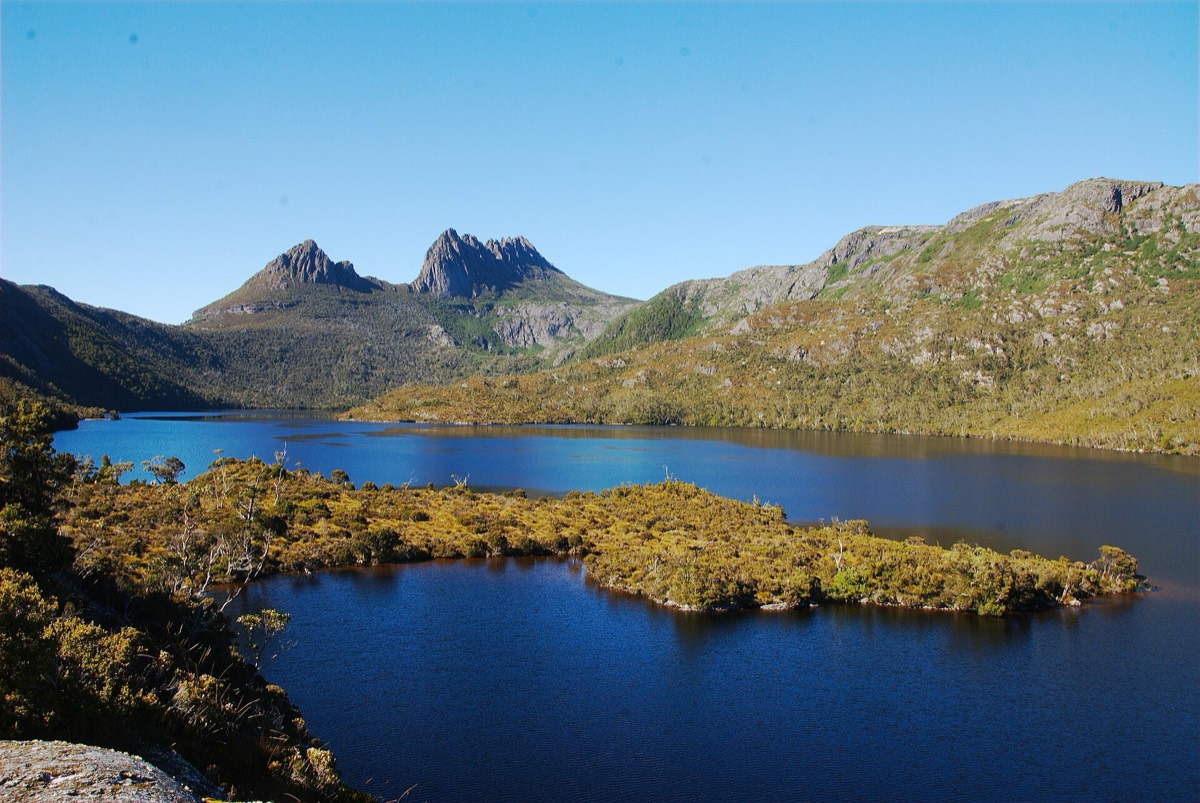
Australia · Mixed
UNESCO World Heritage site since 1982Tasmanian Wilderness
What entry costs
Why it's on the list
UNESCO lists a place when it meets at least one of ten criteria. Tasmanian Wilderness meets six, in our own words:
Rare evidence of a culture
Unique or rare evidence of a civilisation or cultural tradition, living or lost.
Criterion (iii)
A landmark of its kind
An outstanding example of a kind of building or landscape that marks a stage in human history.
Criterion (iv)
Natural beauty
A natural wonder, or a landscape of exceptional beauty.
Criterion (vii)
Earth's history
A record of the Earth's history: its rocks, fossils and landforms.
Criterion (viii)
Living ecosystems
Shows ecosystems, and the plants and animals in them, still evolving.
Criterion (ix)
Wildlife
One of the most important places for wild plants and animals, including threatened species.
Criterion (x)
On the map
Where the site is, and the places around it. Tap a dot for its price. Open the full map
Cultural Natural Mixed Other famous sights Prices checked In Danger
Map: OpenFreeMap, OpenMapTiles and OpenStreetMap contributors. Site positions from UNESCO's open data. "In Danger": on UNESCO's List of World Heritage in Danger.
Nearby
Within 100 km (62 miles), as the crow flies.
World Heritage sites
None within 100 km. The nearest is Royal Exhibition Building and Carlton Gardens, 600 km (373 miles) away.
About the listing
- Country
- Australia
- Type
- Mixed
- Listed by UNESCO
- 1982
- Extended
- 1989
- Area
- 15,842 km² (6,117 square miles)
Questions
When did Tasmanian Wilderness become a World Heritage site?
In 1982, when UNESCO added it to the World Heritage List; it was extended in 1989.
Why is Tasmanian Wilderness a World Heritage site?
UNESCO listed it for meeting six of its ten criteria: unique or rare evidence of a civilisation or cultural tradition, living or lost; an outstanding example of a kind of building or landscape that marks a stage in human history; a natural wonder, or a landscape of exceptional beauty; a record of the Earth's history: its rocks, fossils and landforms; shows ecosystems, and the plants and animals in them, still evolving; one of the most important places for wild plants and animals, including threatened species.